NVIDIA closed out its fiscal second quarter of 2027 with numbers that would have sounded like fantasy just two years ago: $96.22 billion in quarterly revenue, up 106% year-over-year, and a forecast that puts the company on track to report its first-ever $100 billion-plus quarter this fall. Yet the stock’s initial reaction on August 26, 2026 was oddly muted — even negative in the regular session — because the headline growth story is now sharing the stage with a subtler one: gross margins are stepping down, operating expenses are climbing as the Rubin platform ramps, and next fiscal year’s growth rate is guided to moderate from triple digits into the high double digits. This is what a maturing hypergrowth story looks like from the inside, and it’s worth unpacking both the beat and the caveats before deciding what it means for NVDA and for anyone trading the AI infrastructure theme — including on KCEX, where NVDA/USDT futures let traders take a position on the stock around the clock.

Q2 FY2027 By the Numbers: A Beat Across the Board
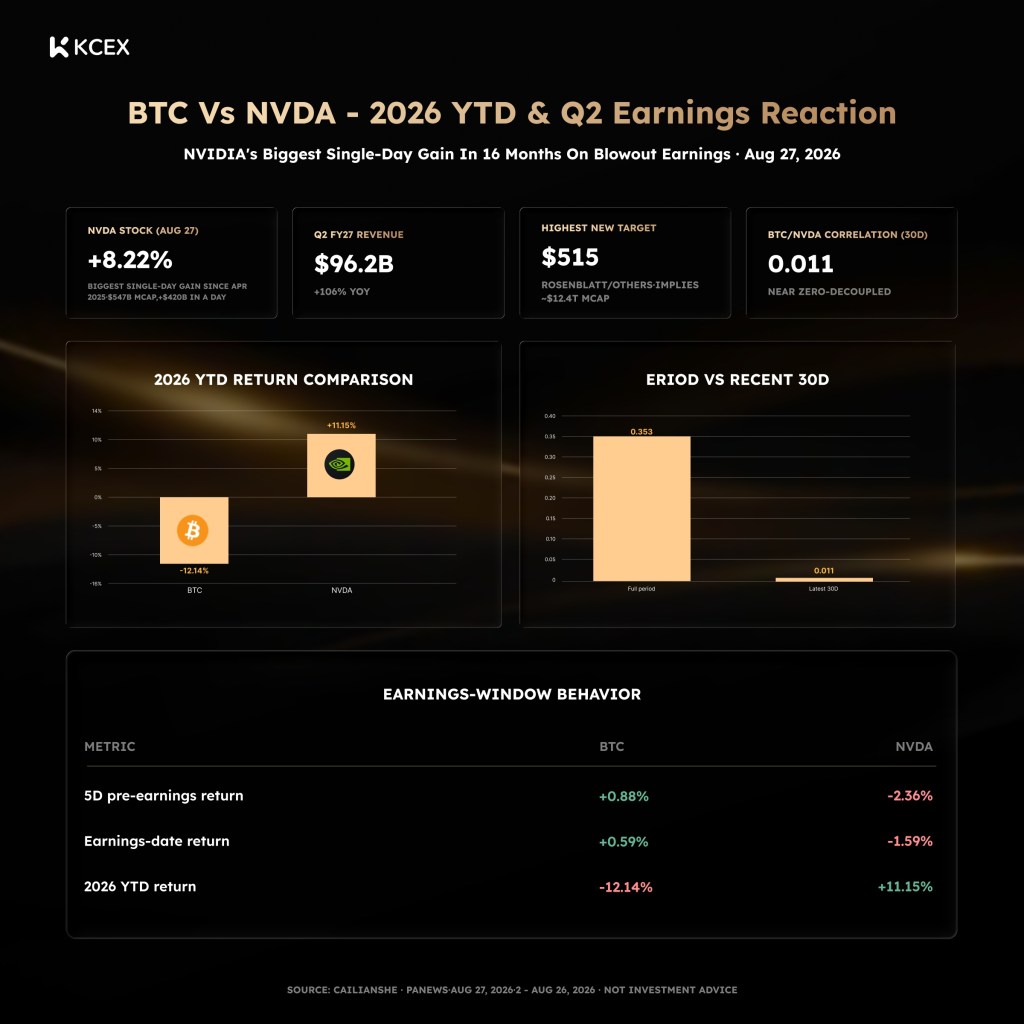
According to NVIDIA’s official earnings release, second-quarter revenue landed at $96.22 billion, comfortably ahead of the roughly $92.17 billion Wall Street had modeled, and up 18% from the prior quarter on top of that 106% year-over-year gain. Data center revenue — now the company’s core business by a wide margin — came in at $89.0 billion, up 117% year-over-year and accounting for roughly 93% of total sales. GAAP operating income hit $63.7 billion and GAAP net income reached $59.7 billion, while non-GAAP diluted EPS of $2.22 beat the $2.08 consensus estimate. NVIDIA also returned roughly $26.0 billion to shareholders in the quarter via buybacks and dividends, with $99.0 billion still authorized for future repurchases.
Every one of those figures cleared the bar analysts had set. So did the forward guide: NVIDIA told investors to expect $108.0 billion in third-quarter revenue, plus or minus 2%, versus a roughly $104.19 billion consensus — a beat on the beat, and the first time the company has guided above the $100 billion mark for a single quarter. At a 90% year-over-year growth rate, that guidance alone would have been the story in almost any other earnings season.
The Real Story: Margins Are Stepping Down
What tempered the market’s enthusiasm wasn’t the top line — it was the bottom line trajectory. Gross margin held at 75.0% in Q2, matching prior guidance, but NVIDIA guided Q3 gross margin down to approximately 74.0%, plus or minus 50 basis points. A single percentage point might sound trivial, but at NVIDIA’s current scale it isn’t: as one analyst framed it in coverage from FinanceFeeds, “one point of margin on a $108 billion quarter is more than a billion dollars” in gross profit. That’s the kind of number that gets a hypergrowth stock’s most bullish holders to pause.
Operating expenses are climbing too. Non-GAAP opex came in at $8.232 billion in Q2 and is guided to roughly $9.0 billion in Q3 (about $9.2 billion on a GAAP basis), a step-up that management ties directly to the ramp of the next-generation Rubin platform and continued AI-factory buildout. NVIDIA has also disclosed a multiyear memory supply partnership with SK hynix, a signal that rising memory costs — not just Rubin ramp spending — are part of what’s pressuring margins as the industry races to keep up with demand for high-bandwidth memory.
None of this means profitability is deteriorating in any absolute sense — NVIDIA is still printing 74–75% gross margins that most semiconductor companies would consider a fantasy outcome. The shift is directional: margins compressing from a peak, rather than expanding further, and investors are now pricing that trajectory rather than the raw growth number alone.
The China Wildcard: Guidance Assumes Zero
One of the more consequential details buried in the guidance commentary is that NVIDIA’s $108 billion Q3 outlook assumes zero data center compute revenue from China. That’s a deliberately conservative baseline given the ongoing uncertainty around US export licensing for advanced AI chips into the Chinese market. It also means the guidance carries meaningful upside optionality: any resumption of China compute shipments, even partially, would land on top of an already-record forecast rather than being baked into it. Investors weighing NVDA’s near-term setup should treat the China line item as a call option embedded in the stock rather than a risk to model out — the downside is already assumed away in the official guide.
Jensen Huang’s Framing: “Compute Is Revenue”
On the earnings call, CEO Jensen Huang leaned into a reframing of the entire AI infrastructure narrative. “AI has reached its inflection point,” Huang said. “It’s doing useful work. Its tokens are productive and profitable. Now, compute is revenue.” The line matters because it directly addresses the market’s biggest lingering worry about the AI trade: that hyperscaler and lab capital expenditure is running ahead of monetization. Huang’s argument is that AI compute has crossed from being a speculative cost center into a self-funding, revenue-generating asset — because the tokens that GPUs produce are now being sold, licensed, or embedded into paid products at scale.
Huang also pushed back on the idea that NVIDIA’s growth is concentrated in one or two anchor customers. “This time last year, one lab alone was driving the buildout,” he noted. “Today, we have a golden age of new AI labs and startups, multiple frontier labs scaling in parallel, a thriving open-model ecosystem and physical AI coming online — with strong momentum across the U.S. and around the world.” That diversification argument is central to the bull case for sustained demand even as any single customer’s spending plans shift.
Rubin’s Full Production Ramp and the FY2028 Outlook
NVIDIA confirmed that its next-generation Vera Rubin platform is entering full production for the coming product cycle, positioning the company to supply the next wave of AI factory buildouts as compute demand scales beyond what current Blackwell-generation systems can handle. Alongside that update, management guided for approximately 70% revenue growth in fiscal 2028 — an enormous number in absolute terms, but a clear deceleration from the 106% year-over-year growth NVIDIA just posted in Q2 FY2027.
That’s the crux of how to read this quarter: growth is still explosive by any normal company’s standard, but it’s moderating from triple-digit to high-double-digit territory as NVIDIA’s revenue base gets large enough that maintaining a 100%+ growth rate becomes mathematically punishing. A company generating $108 billion in a single quarter simply has less room to double again and again — the law of large numbers starts to bite, even for the best-positioned company in the AI buildout.
How the Stock Reacted
NVDA shares actually closed down roughly 1.6% during the regular session ahead of the print, reflecting pre-earnings nerves after the stock’s huge 2026 run, before rallying about 4% in after-hours trading once the beat-and-raise results and the FY2028 growth framing landed. That whipsaw — down into the print, up on the release — is a fairly typical pattern for a stock this large and this closely watched: expectations were already sky-high, so the market needed to see both the headline beat and reassurance on the margin and demand-durability questions before re-rating higher.
What This Means for Traders
For traders and investors tracking the AI infrastructure trade, this print reinforces a few practical takeaways. First, the demand side of NVIDIA’s story remains intact and arguably strengthening — a $108 billion guide that assumes zero China revenue, layered on top of Huang’s “golden age of labs” framing, is not the profile of a company facing a demand air pocket. Second, the margin and opex trends are the metrics to watch going forward more than the top-line growth rate; a company can beat revenue estimates every quarter and still see its stock re-rate lower if profitability trends deteriorate faster than expected. Third, the shift from triple-digit to ~70% growth for FY2028 is a normalization, not a red flag, but it does mean the market’s tolerance for any additional disappointment on margins or China policy will likely be lower than it was during the pure hypergrowth phase of the last two years.
Trading NVDA on KCEX
Earnings events like this one create exactly the kind of volatility that futures traders look for — a beat-and-raise headline, a same-session round trip in the stock price, and a multi-week debate ahead about margin trajectory and China exposure. On KCEX, you can trade NVDA/USDT futures to go long or short on NVIDIA’s price action around catalysts like this one, with leverage and around-the-clock market access that traditional equity markets don’t offer. Whether you think the Rubin ramp and China optionality set up further upside, or you’d rather position for margin-compression concerns to weigh on the stock into the next print, KCEX’s futures market lets you express that view directly.
Frequently Asked Questions
What did NVIDIA report for Q2 FY2027?
NVIDIA reported $96.22 billion in revenue, up 106% year-over-year and 18% quarter-over-quarter, beating consensus estimates of roughly $92.17 billion. Data center revenue was $89.0 billion, up 117% year-over-year, and non-GAAP EPS of $2.22 beat the $2.08 estimate.
What is NVIDIA’s Q3 FY2027 guidance?
NVIDIA guided for $108.0 billion in Q3 revenue, plus or minus 2%, ahead of the roughly $104.19 billion consensus estimate. That would represent NVIDIA’s first-ever quarter above $100 billion in revenue and roughly 90% year-over-year growth.
Why are NVIDIA’s margins declining?
NVIDIA guided Q3 gross margin down to approximately 74.0% from 75.0% in Q2, citing rising costs tied to the Rubin platform ramp and AI-factory buildout, alongside broader memory cost inflation across the industry — reflected in NVIDIA’s new multiyear memory supply partnership with SK hynix.
Does NVIDIA’s guidance include China revenue?
No. NVIDIA explicitly stated its Q3 guidance assumes zero data center compute revenue from China, given ongoing export licensing uncertainty. Any resumption of China shipments would represent upside to the current forecast rather than a risk already priced into it.
What is NVIDIA’s growth outlook for fiscal 2028?
NVIDIA guided for approximately 70% revenue growth in fiscal 2028, a deceleration from the 106% year-over-year growth reported in Q2 FY2027, reflecting the natural moderation that comes with a much larger revenue base.
Can I trade NVDA around the clock?
Yes. NVDA/USDT futures on KCEX allow traders to go long or short on NVIDIA’s price movement outside of traditional US stock market hours, which can be useful around earnings releases and other after-hours catalysts.
Final Thoughts
NVIDIA’s Q2 FY2027 report is a snapshot of a company still growing at a pace that would define the career of almost any other business, now entering a phase where the market is scrutinizing the quality of that growth as much as its size. A $108 billion guide that assumes zero China revenue, a CEO reframing AI compute as self-funding rather than speculative capex, and a Rubin platform ramping into full production all point to durable demand. At the same time, a step down in gross margin, a rising opex base, and a guided deceleration toward ~70% growth in FY2028 are reminders that even the best-positioned company in the AI buildout can’t out-run the mathematics of its own scale forever. For traders, that combination — explosive but moderating growth, embedded optionality on China, and margin trends worth watching closely — is exactly the kind of setup worth tracking closely into the next print.